

"If you don't know how medical businesses
become successful every time, how can
you recognize and avoid mistakes that
make them fail so often?"
The full story behind this physician's medical practice downfall isn’t unique, nothing to excite the non-fiction writers about, unless it can be defined as a model of what not to do in private medical practice management and medical practice business management.
Having absolutely no background business knowledge, college courses, or medical school education about medical practice small business management, office business education and management, or small business marketing strategies at the time I started my private medical practice, I never thought, let alone even considered, this knowledge would be of much value to me.
That same belief, unfortunately, has persisted for a century in our nation among all physicians with
all the same regrettable consequences.
Over 40 years later, I learned that the lack of a business education, marketing knowledge, and my willful ignorance of business reality had evolved from the carefully hidden medical school's weapon of mass destruction that today is responsible for the rapid destruction of private medical practice, the increasing attrition of physicians, and the wide spread loss of medical practices by the hundreds, of private practice physicians for financial reasons.
The weapon of mass destruction of the medical profession are the medical schools intentional failure to provide a business education for all medical students throughout our nation. That tragedy continues to support our government's plan to take full control of healthcare and the medical profession itself.
During all those years of education and training, never once can I remember any mention by anyone during college or medical school that having the knowledge to effectively manage a small business was critical to medical practice business success. It must have been mistakenly assumed that all college and medical school students already knew that.
But, taking action on providing the necessary business education by the medical education scholars, even if that was the case, will never happen until the healthcare revolution begins, until physicians wakeup to the destructive consequences of managing a private medical practice with no business knowledge, and all medical schools in our nation are forced to recognize their obligation and responsibility for providing a business education to all medical students, at the very least.
Success is defined here as the ability of any physician in medical practice to reach maximize practice potential in terms of income, service to patients, ever-improving skills, and complete attainment of all goals any physician visualizes from the beginning, for his or her lifestyle and practice evolution.
Unfortunately, even today, most physicians continue to consider small business office management knowledge and systems like a popcorn movie—entertaining, but nothing of practical value. Something worth thought, but not action.
Over the next 20 years in private practice I gradually came to recognize the covert signs of a doomed medical practice. I am ashamed to admit to anyone that I didn’t know how to handle the quicksand of disabling financial factors which surrounded me in my private medical practice.
I say this with the recognition that those unrelenting factors were simply the features of the landscape that I was entirely responsible for managing and resolving, as all physicians should. It's a failure of self-discipline required by potential medical students regarding what is required for successful medical practice (know all the rules before you play the game).
The specific events, which spelled out and magnified my medical practice business ignorance, were...
1. Violating common sense budgeting for the business...
By the third year in private practice I had an opportunity to purchase a small medical building with 5 medical office suites with a very small down payment, and paid the mortgage with the lease income paid by the physician tenants. Seemed like the right decision and good investment... right?
But, to add wood to the fire, my next decision soon after was to spend about $70K to renovate and upgrade my own office in that building and figured I’d pay for that over the next 15 years, never considering I might need to move elsewhere sometime, or struggle with the patients attrition from my practice, or confront my tenants might move out, or be side-swiped by the uncertain national economics of medical practice which might change for the worse (as they did in 1976).
- Going into heavy debt just never worried me... big mistake!
Have you ever had the feeling that you could handle any financial
debt that came along?
- Certainly, relying on my overconfidence and professional status, how could I lose no matter what came along? Could sound business knowledge have prevented this... I’d like to think so.
- My CPA sure didn’t help me. My corporate attorney didn’t whisper any suggestions either. None of my family had any business expertise to offer me. I never knew what a business consultant was good for, nor if they knew anything about medical practice business management since they were not physicians.
Note: The fundamentals and principles of successful business are
the same for any type business, anywhere.
2. My vision of my life in medical practice disappeared...
I’ll never know why, but one day I sat down about 5 years into my practice to try and figure out how my medical practice was doing and get an idea of whether it was going anywhere.
I’d never even thought of keeping statistics such as the number of new patients each month, or on anything else related to measurable statistics that would have been a far better indicator of how my practice was doing.
So, I relied on the monthly financial statements from my CPA (huge mistake), which I really didn’t know how to read or make sense of in any effective manner as a means of formulating critical decisions about my practice business—not that you have ever been there too. The methodology I was using was like rearranging the chairs on the deck of the Titanic.
I read the numbers, calculated amounts, categorized the results, and came up with what Winston Churchill called, “A riddle wrapped in a mystery inside an enigma.” Evidently, I had boarded the clue train leading to alternative possibilities. One thing was abundantly clear.
It would never be possible for me to make enough money in my practice of OB-Gyn to pay for my three kid’s college education, nor ever be able to fund a retirement plan to any sufficient level. I based all that on inappropriate accounting fingerprints and chasing the wind of prophesy.
Psychologists, spiritual leaders, self-improvement experts, and mind benders can very well look at my behavioral pattern as a true example of collective insanity, intellectual immaturity, or need for a
psychic hotline.
They’re probably right, within certain bounds and without knowing my personal attributes. But, when it comes to comparing myself to other physicians, then and now, I wonder how many of them were a mediocre jockey on a hell of a horse.
My thought was, “I’ve gone through the entire educational gauntlet, sacrificed years of my life to my ambition, invested thousands of imputed dollars in the process, and now I see that what I had to show for it—it stinks (a replacement word for the ones I was originally thinking)”.
How could I resolve my practice dilemma (or how would you)?
----Start a new career that offered more financial gain?
----Start a sideline business to supplement my income?
----Become a paid employee of a managed care group (again)?
----Move my practice to another area?
----Work longer and harder daily till I burn-out (about 4 years)?
----Focus my practice on high income patient procedures?
----Retrain as a plastic surgeon or anesthesiologist
(highest income specialists among several others)
Considerations...
You will never convince me that you haven’t run these thoughts through your own mind from time to time and noticed some form of mental heartburn.
Although you can put yourself in my position and probably can understand the unending analyzing and agonizing one must go through under those circumstances, and perhaps you have already...
a choice had to be made.
The choice of taking on medical practice business management and medical practice marketing strategy courses should have been added to the list above and would have been a better choice than most of the others. Unfortunately, those business options remained unappreciated as a business tool among most physicians at the time—even today.
Note: I still can't fathom the utter total disregard by the elite medical school educators responsible for arming physicians with the business tools and strategies for medical practice that increasingly accounts for the increasing present-day attrition of physicians. Think about fee restrictions and how many practices are failing from dropping incomes.
The opposite question comes to mind. "If physicians don't need a business education, then why aren't all physicians wealthy, as most of the public believes, even today?"
Because most of the choices involved extra costs, some time away from practice, and my own rigid thoughts about what I mentally and physically could and couldn’t tolerate, I decided to do real estate investing as a sideline business. It seems to be such an outrageous synthetic experience when
I look at it now.
Here, I couldn’t even think of a practical way to inject my practice with growth hormone, and then went ahead and involved myself in another business I didn’t know how to manage, but believed it would be much easier to learn, than memorizing the origins and insertions of all the muscles in the body. It was and is.
Problem is, outside forces which have direct effects on real estate investing success ran the red light and t-boned me right where it hurt.
It didn’t work out as I had planned--but you already guessed that. I lost everything except my practice—back to page one. Would all of this have happened if I had been educated in the basics and principles for managing a small business (involving marketing as an integral part of that) as well... maybe.
When you suffer from the lack of medical office business principles, here are a few examples to show you about my malnourished business system.
1. My complete incompetence in managing employees
Although most physicians are able to eventually, after a Sabbath journey to reach holy ground, reluctantly accept the “spontaneous” medical office management system that ultimately emerges among his or her employees without any effort on their own part. It’s an inevitable source of
practice destruction.
I know because I used that system, never understood how to make it any better, and many times sat behind my desk after everyone had gone home and had what Pastor Joel Osteen calls a “pity party” for myself. Did I really do that? I can't believe I did!
But then, as the decision maker, I always remembered the saying, “If you’re not ahead of the threat, you’re reacting to it.” And, boy was I reacting to it, especially when I found out certain things going on with my employees behind my back in my office such as...
My receptionist secretly using the copy machine to print up her church bulletins for the congregation weekly without my knowledge. She had been doing it for almost a year before I found out it had
been happening.
2. Example of my working “in” my business instead of “on” my business...
My front desk employee assigned to do all the left over filing, answering the phone, and keeping the office open and running on Wednesday when I was not there, decided on her own to close up the office, put the phones on the answering service, and have a free day off to do her personal
things for herself secretly.
The other employees knew it and never told me. I made the discovery when I met up with her one Wednesday moving through the shops in the mall. Did I fire her? That’s my next section of
discussion below.
3. The importance and danger of employee comradery...
It didn’t mean to me any more than social interaction happening around the office until the truth slapped me in the face. I decided to send my top notch back office staffer to an Ultrasound training course about 90 miles away so she could also do my office OB ultrasounds.
She was not able to tolerate being without her husband for the 2 1/2 days at the meetings and insisted he go along. I paid for everything for the venture including hotel, food, travel and the course... Oh yes, I forgot to mention her usual salary she earned while at the meetings, which
I also paid.
A couple weeks later I found it necessary to terminate my front desk employee. Within two days the back office employee that I had just paid hundreds of dollars to educate in ultrasound procedures quit also with no notice.
The back office employee knew why I had fired the front office lady and what she had been doing behind my back unethically. I had no idea they were such closely attached friends and bound by their own “employee honor system.” It created a perfect window for her to quit because the firing of another employee created the perfect opportunity for her to leave also.
Of course, the back office employee, after spending over a thousand dollars on her training, being nice enough to pay for her husband’s vacation with her, and for 7 years in my office learning medical office functions, never mentioned she was thinking of quitting, yet abused my generosity without a second thought.
She refused to explain why she was quitting but I suspect she had already lined up a job in another OB physician's office to do his ultrasounds--for higher pay as a result of her free training and a valuable educational experience.
Lesson: If you pay for the medical education for your employee, or even if they pay for it themselves, you should expect to be coerced into a higher salary for that person. In every case it's smart to sit down with the employee beforehand to determine their thoughts, plans and alternatives regarding what they expect from you.
Will they be demanding an increase in salary? Or other benefits? Are they intending to get a higher paying job elsewhere after the training? Of course, the answer will be no, but if true then the inconsiderate response will permanently remain in their subconscious memory banks for the rest of their life.
If they paid for their own education, then these increased benefits would seem appropriate... but not if you pay for it.
Can you stomach the results when you let your medical office run itself?
My blunders should be a resounding wake-up call for you to start marching to a
different drummer.
Blunder #1
I wanted everyone to like me, especially my employees because I have always been a very generous person, easy to like and work with, made few demands on my employees (Big Mistake). My very first office employee was an older lady that I shared with two other consultant physicians from the
next town.
She was very likable, friendly with everyone instantly, and could charm any hostile patient right out of their "pull-ups." Her experience in medical office work spanned many years. Her choice of working only part time enabled me to hire a full time office manager after we moved to my own office suite. She was happy doing my medical office billing and collections part time.
Twenty years later she was still there doing the same job. I could never let her go or replace her in spite of the poor job she was doing because she was my greatest promoter, seemed to know everyone in the medical community, had more connections with other medical offices than anyone else, and bragged to almost everyone how great a doctor I was and how wonderful I treated
my patients.
My office income wasn’t the best and the billing processes often came up lacking, but new patients kept coming in with her name in hand.
She remained a close friend to my wife and I. I was trading a relationship for practice profits which at the time seemed a good thing. I learned that my emotions often misled my duty to my business.
Another lesson I learned was far more of a disruption of my office management than anything else. All along I had the strong belief that the office staff that I had hired were good enough for me and my business. I thought also that after firing someone, I would not be able to find another person to replace them, at least not easily or within a few days.
Those thoughts and beliefs were totally wrong, and discovered that I was mentally not able to fire anyone because of my personality. I had my office manager do that. But most of the time staff members left my office because of personal changes they made in their living circumstances--
never fired.
Let's face it, it's what Michael Gerber, author, consultant and business advisor to hundreds of physicians calls a “physician employee.” He describes me exactly in his book, The E-Myth: Physician, as a doctor who settles for a mediocre medical practice that seems just “good enough”... not perfect, not dramatically growing, not exactly what you dreamed of, just OK!
Yes, I should have replaced her right at the start instead of having to worry all those years about what practice income she lost in her shuffle this week. Without a change in my personal business management mindset, I doubt I would have done the same again.
Note: You can't be close friends with your employees and manage your office efficiently.
Friendly, is enough.
Blunder #2
It was one of those examples of how a employee reward system over time became “expected” rewards on a regular basis without any increase in their work efforts, efficiency, and productivity. My fault. You see, my thinking was and is commonly what many doctors still think, rewards = results. Absolutely, not true! Rewards don’t increase motivation. It has to come from inside.
An example of the extremes I went to in order to fortify my self image were a bit unusual and overly generous at times. My excitement about how well my medical practice was growing, mixed with some social jujitsu, and a neck wrestling desire to reward all my employees, led me into objective amnesia concerning the event.
After appropriate arrangements were made, office closed for the day, we piled into a commuter flight from San Francisco to San Diego for a joyous day of sport and entertainment. We toured “old town,” made it through Sea World OK, spent the rest of the time shopping on the waterfront, and had a great meal at a fine restaurant before flying back to the bay area. Naturally, it didn’t cost the
employees a nickel, except for the personal purchases they made.
The rewards day became the topic of conversation in the office for the next few days, the thank you’s were plentiful, and the office work never improved. Sometimes, when you show the caveman “fire,” it triggers an increased responsibility and loyalty--but usually not in reality in most
medial offices.
Another of my similar such inspiring attempt at "business smarts" a couple years later resulted in a good face licking, but not much more. In another of my eureka moments I arranged for a special dinner meeting for all my employees and their spouses at one of the most expensive elegant restaurants in town.
Near the end of the dinner I presented a unique shiny 14 inch beautiful wooden wall plack to each employee which included a gold plate engraved with their own name and a short summary of the excellent work they had done in my office.
Below the name was a 4 to 6 line personal description I wrote about their expertise and value to my office team. It impressed the hell out of the employee’s significant other and was a terrific way to praise my crew and was sincerely appreciated. My mistake was not taking advantage of the follow-up and demand more from my employees.
Blunder #3
This has to do with my hiring and firing high octane incompetence. Of course, it was the first time in my life I had to do such things, and had absolutely no understanding of the best hiring strategies, interview process, format for extracting information from the candidate, or qualities a candidate needed for working in a medical office.
Experts tell us to “hire slow” and “fire fast.” Thirty years later I finally heard that.
I had invested a considerable amount of money in an office computer system in the early 1980’s knowing that it would increase office efficiency. Of my six OBGyn physician associates, I was the first to acquire a computer system. None of my office staff were computer literate business wise and had to be trained.
Shortly after, I hired a member of the computer sales company's training team who lived close by and seemed well qualified for medical office work. I didn’t really interview her (bad decision), just asked her if she would like to work for me full time.
The fact that physicians could shift to personal computers to run their offices was totally new to me but I saw the future of its value. So I became the first physician in my area to have a computer in the office, knew absolutely nothing about them, but had an office manager who did.
The computer instructor that I hired had chuckling boisterous personality along with being mentally sharp was a cover for her overly ambitious personal agenda. My first clue of an upcoming series of rug-stomping antics showed up on day-one of her job. Everyone of my employees were required to wear an office uniform, or white coat and never complained.
This lady, once hired, flat refused to wear a uniform or a white coat. It angered me, but I rationalized (another mistake) my acceptance of her choice not to comply because she knew computers inside and out and would be an asset to the office.
She refused to pull all the patient charts of the patients scheduled for the next day for office visits in the evening before she left the office. When patients came in the next day, one of the other staff members pulled the charts for each patient as they came in.
She refused to arrive at the office 20 minutes early to unlock the door and prepare the front desk for patients arrivals. It was her assigned job from the start.
Note: You must convince yourself of the need to fire an employee who repeatedly challenges your tolerance because they won't change. You will be manipulated if you forgive them, and the longer you delay the issue the harder it is to terminate them. They are more often than not a bad influence on the rest of your employees and disrupts office efficiency.
Over and over again she continued to be a problem, and I continued to rationalize each time. She knew exactly how to manipulate me and do exactly what she chose to do using her computer expertise as leverage.
After tolerating her antics for a few years, feeling all along I would never be able to find a good replacement (wrong again) for her expertise, she had to be fired. I mentally could not do that procedure (what a wimp). My office manager fired her.
The rest of the employees, were happy she was leaving. I had no idea they felt that way. The office staff members were well aware of her manipulation tactics she even used on them. Remarkably, the other employees chose to never once come to me and tell me all she had been doing which I never found out about.
The whole experience woke up my sixth sense for the first time, drove red hot spikes through my brain to keep reminding me, raised the bar on employee qualifications, established new rules of engagement with my employees, and became a permanent example of the complexities of medical office hierarchy--I thought!
Comment about incompetence...
I am way too ashamed to tell you about the rest of my business incompetence's. What is amazing to me is the fact that most physicians suffer with some of these disabilities, know it, contend frequently with them and never do anything about it just like I did for so many years. Getting unstuck from this mindset is not difficult once you know how to go about it (Part 2 of this article).
In the next article on this topic I will discuss in detail each of my operational hiccups noted above and how you need to feed your mind with the right stuff, avoid these perpetual hassles, and develop a mindset appropriate for good medical practice management and reliable medical practice marketing using the tools I will tell you about.
Feedback always welcome!
----Professional Probe----
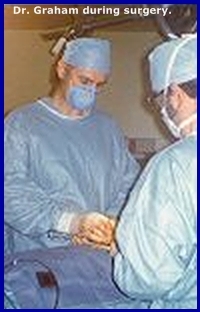
"What's more credible than a photo of the author doing
gyn surgery at Mt. Diablo Hospital, Concord, CA (1985)"
At the time of this photo I was on staff of four local hospitals in the area. The two joined cities of Concord and Walnut Creek, had a population of over 200,000. It was a 20 minute drive to downtown San Francisco, when it was clean and law abiding with fantastic restaurants, Oakland Raiders and San Francisco 49ers. John Madden lived in Blackhawk about 5 miles below Walnut Creek. Schools were excellent for our 3 kids. Tahoe skiing was a 3 hour drive away.
I truly have a lot to be thankful for.
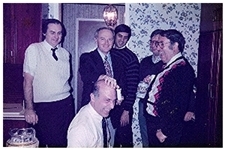
"This was our private medical practice OBG
call group in the 1970s-1980s"
Back row----myself, Bob Mayo, Alan Kaplan, Dick Seibert, Rafael DelValle
Front row----Dan Chuba
****All were board certified, fantastic doctors, and cream of the crop in our area--great people and families. I was proud to be able to practice with them.
Articles © 2013-2022/CGG INVESTMENTS LLC. All rights reserved. #8 3-15-22
