

"Has anyone told you about such jobs? I seriously doubt it.
They do exist silently out in the open. I want you to
know about some of them that any practicing physician
can add on to their daily practice chores easily and spend
less than 30 minutes a day on them earning income."
I want every physician to be aware of a plan-B for financially building a retirement plan, send your kids to the right colleges, and living an upper class lifestyle among other wants or needs when your medical practice is not up to doing the job. A means of saving your medical practice from financial failure might be another more important purpose.
Medical Economics publishes a litany of articles telling you about what to do about moonlighting or other medical jobs for you to do outside of medical practice after you retire or you lose your practice for financial reasons. The problem is that almost all don't keep you at the professional level that as a physician you have worked for all of your medical career.
What's out there that you likely never have heard about that can radically change your life and income forever...
You will at first twist your face and call it BS. That's fine with me. For those who maintain an open mind there are innumerable opportunities out there if you care about reading more here and now. It's what I have found and been doing for the last several years out of my own desperation regarding my insufficient finances/income.
This process that I'm telling you about is never publicized and unless you are already involved in the stock market, you still may well be unaware of what I'm revealing to you.
In my about 40 years in the clinical practice of medicine it is rare that I would find a physician with a business education or a significant knowledge about economics and money management, such as I have today. And these things have been leading huge numbers of physicians over the past 8 decades into what I call "Professional poverty." That has to stop NOW.
A bit of stock market enlightenment is required...
You already know about stock exchanges, stock brokers, and the stock market in general terms. Have you ever registered to use a stock exchange to trade stocks at? Have you bought and sold stocks before? Anyone in a matter of 10 minutes can register and be approved for trading at any of the 50 different stock exchanges in the USA within 48 hours or less.
There are three primary segments of the stock market. First, and most well known, are the huge Wall Street stock and currency trading markets where brokers are born and raised to make the trading easier for investors to buy and sell their stocks or bonds.
Second, is the arena where investors who know how to use the stock market and trade daily 5 days per week in. They are called "Retail traders. "They do their own thing, use their own knowledge about the market, don't usually work through a stock broker. Statistics show that those who play the trading game by themselves---that 98% of them will lose all of their money eventually.
Third, is the central level of stock market interactions, called the Financial Publishers Industry. This level of the market is composed of certified stock brokers that became sick and tired of helping the rich get richer, and desired to help the little guys, you and me, make money by trading.
These brokers know and follow the legal rules of the stock markets as well as all the secret strategies, dark markets, how the rich get rich, and all the secret tricks used by experts to earn money in the market.
This part of the market has become loosely organized groups of brokers, some of which are named... Money Map Press, Oxford Club, Agora Financial, WealthPress, and more than 50 more that are smaller, sometimes only one broker, some have 20 or more in their group. Larger groups organize so that each broker spends most of his or her time on one element of the market trading like...plain stocks, options, currency, forex, and a few more.
The primary advantage for clients is that they can choose to follow the one broker who specializes in one area of the market that the client is most interested in or feels comfortable using to invest. The second big advantage is that these groups for the most part do a lot of teaching investor/clients about the stock market and stock investing. Most of the stock exchanges have loads of videos and instructions for clients to learn from as well.
A minority of these groups, usually the least popular ones, do very little teaching, so investors have to sort through most of them to find the one or three you like to work with. I have gone through that process and sorted out about five groups that I trust their advice and
teaching methods.
The more technical aspects of the best groups...
Each broker member of a group has already limited his concentration to the top two or three areas of the stock market that he likes---even though he or she is fully capable of trading in all elements of market trading.
There are literally hundreds of ways to buy and sell stocks and those are the sources used by each broker to create his or her set of trading programs, to which each has a name. A program is offered to clients and they purchase it if it meets their personal purposes in investing. Programs during the best market times for growth (bull markets) cost from $1,500 per year to $15,000 per year, depending on the elite level of the groups.
Today (October 2021) when the stock market is lousy for investing, the costs of programs varies but have dropped over 50% in price. It's Biden's new economy that the Democrats created.
Sorry, I'm biased.
What makes up a stock investment program and how does it work?
Most of the programs include video training, bonus reports, emails of info, SMS messages, and many educational ZOOM meetings on multiple market topics that make the program easier to use. All have a support phone number to get help and info that are better than average
quality responses.
The good investing programs can be terminated anytime, but in most cases there is no refund of the year cost that has to be paid in total all at once at the beginning.
I receive stock market newsletters from each and every program I joined about the condition of the market, the list and profile of every stock they have recommended to buy or to sell. When a stock or option is recommended along with the extensive data on that company, I choose to either buy or not buy the stock. Often there are many stocks recommended and several I'm advised to sell if I own them.
The statistical data concerning the recommended stock/symbols are analyzed over periods of time so that the predictability of the profitable stocks can be closely confirmed. These groups have multimillion dollar banks of computers loaded with algorithms picking out the stocks that the hundreds of indicators indicate have shown to have the highest probability of profiting.
Across the Financial Publishers network of stock broker groups the results of several years of data confirm that the stock recommendations made by these brokers run an 80% probability of profiting in the investment. So each investor has to choose to take a one chance in 10 of losing money on that stock---or an 8 our of 10 chance of profiting on that stock. Those individuals who are fearful, or hesitant to take that amount of risk should find something else to invest in.
I have found it very comfortable to profit 80% of the time using this method of investing in the stock market. Anyone can start with 50 or 100 dollars and increase the investments as you get comfortable with the method and income. It's like boiler plated income. They tell you in an email and on the smart phones what stock, when to buy it and at what price in the Bid and Ask pricing system, and send the instructions when to sell the stock and why.
You get the email or SMS or both during the day when you are practicing. There is no need to sit at your computer for 8 hours straight every day like so many investors do.
When you get home, walk over to your computer, read the recommendations in your email, pick out the ones you want to invest in, spend 10 minutes using your stock exchange---TD Ameritrade, Schwab, Fidelity, Interactive brokers, Robinhood, Tastyworks, Tradestation, E-trader, etc.---to buy the stock(s) after supper, and you are done for today.
Then you watch the chart showing the candlestick patterns, green for price up, red for price down for the day. I like StockCharts.com --$20/mo and the ability to look at any USA stock chart 24/7. Options are a little different but not hard to learn to follow those and invest in them as well.
I have watched many videos on teenagers using and investing in the stock market---they learn systems much faster, but have to show and watch them closely. Many college students invest while in school and a few earn enough to pay for college expenses or enough to quit school and do investing full time. The advantage here is that parents can get their kids interested in the stock investing and they can pay for their own education.
In college, if they start investing with these boilerplate like stock investing systems, they might not have to move back home when they don't get a job after college.
What are my personal choices?
The few groups of Financial Publishers that I am comfortable working with in similar programs are RobBooker.com, WealthPress.com, The Oxford Club.com, Agora Financial.com, and DTITraders.com.
My #1 choice is Rob Booker and his group for several reasons...
- Rob is an interesting person, a Christian and donates a lot to charities.
- Rob and his group teach investors far more than any other group.
- Rob is extremely intelligent, communicates daily, and creates new programs every 6 months---lots of ways to win in the market and choose from.
- During his seminars he gives out free gifts in the $500 range.
- Rob's programs are less expensive than all the other groups.
- Markay Latimer, associate of Robs, is not a broker, but is an expert in stock options, which I invest in. Her two option programs that I have used and profited by are...Profit Accelerator
and Profit Zone.
Rob has several programs using different strategies of stock investing. His style of investing is getting in and out of stocks quickly and making thousands of dollars weekly doing that. I use several of them but when the stock market is down, like now in Oct. 2021 and 2022, I switch to his instant income programs like...
- Hot Sheets---sends me email with about 8-10 stock symbols at 5 AM PST--an hour before the stock market opens in NYC at 9 AM EST. We invest with Rob and we invest in any stock opening at 9 AM and jumps up in price in a few minutes or within 1-2 hours, have a target price, get out at or before the stock hits the target. The stock prices are from $3 to $15
per share. - Wiretap Trades---email to me every Friday with 3 stocks and invest in them before the market closes at 4 PM EST.---have fun all weekend---
get up Mon. AM and sell the Stocks after the market opens. - Sleeper Trades---email me hit list of Crypto stocks to trade over night and sell in AM
----Professional Probe----
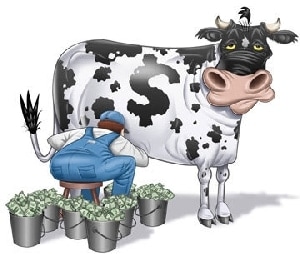
"So what is your cash cow? One valuable
aspect of a business education is
that you are able to easily recognize
where the cash is hidden and how to
liberate it from its hiding place. It's all
right here on this website.
Articles©2013-2022/CGG INVESTMENTS LLC. All rights reserved. #93, 3-16-22
