

"I don't think most medical malpractice
plaintiff attorneys have discovered
this oasis for medical malpractice
claims against physicians yet."
There was a time when the smart phone technology contained a significant danger to all physicians in spite of the convenience it offers to both doctor and patient. I was brought up in medicine to interact person to person with patients.
If Dr. Hopkins caught us listening to the heart of the patient through a shirt or blouse, or not taking the time to specifically listen very quietly for diastolic murmurs against the skin, he would round up a patient with significant pathologic diastolic murmurs that we weren't able to hear unless the stethoscope was on the skin.
Today doctors depend on x-ray, ultrasound, and CT or MRI, etc. to make diagnoses rather than by hands on techniques. It increases the cost of healthcare, reduces the diagnostic skills we were taught, and leaves us dead in the water if those machines are not available. Once you lose your skills, you become hostage to the machines.
I'm much more concerned about the misdiagnosis risks associated with relying on technology. It used to be that a man would walk into the clinic for a laceration of his leg that he got from work and during the undressing process noticed his scrotum hanging down to his knees full of small intestine. Usually men put up with the defect for long periods of time. No visits to doctors, did his own treatments, usually the old fashioned truss support my uncle wore for 20 years or so.
The truss looked like a polished wooden door knob on each side that strapped in directly over the inguinal canals in the groins. Men rarely went to a doctor for medical problems that they could put up with and still do their job. When we as medical students found a patient like this we knew that it was a perfect opportunity for being the first "doctor" to find something else, maybe 3 or 4 other medical problems that needed treating. That puts me in mind of the test patient I was assigned to examine when taking the Part-3 of the National Board exams at Duke University Medical Center.
It seemed evident that if I missed an important medical problem my assigned medical patient had, I'd flunk the National Board Exam. So I examined him head to toe carefully. He had an obvious large inguinal hernia that he didn't complain about. He had several systolic and diastolic heart murmurs, and had an active melanoma on his arm.
I thought I had scored well by diagnosing all three things and doubted I'd missed anything. When I listed all of the diagnoses I had made, the examiner asked me if I had done a breast exam also. The patient was about 80 and rather obese so I never considered in a male the need to do breast checks--I admitted not checking his breasts.
I told the professor that I usually don't examine men's breasts except by my manipulation of the breast tissue while listening to the heart. The man had been admitted for breast cancer, not for any of the other problems and I had missed the breast lump completely. We discussed male breast cancer--5% occur in males--I never knew that, never remembered hearing about male breast cancer in medical school, or even thought of it. Luckily he passed me. But, I never forgot the lesson, nor the patient.
All of these things remind us that many patients have many medical or surgical problems that they never tell doctors about, hide some issues, and we only find them by physical examination of the patient. When we find them, patients are willing only then to listen to the dangers of delaying treatment, what should be done, and what is recommended.
All of the digital technology used will never come close to doing what needs to be done during physical examination of patients. My concern is that doctors are becoming too trusting of remote medical tracking and monitoring. I think it is easy to get into that groove. And when fetal monitoring becomes a home process, all the OBs will run for the hills. It will be a field day for all the plaintiff attorneys.
What are the dangers of remote medical treatment that is so prevalent today in medical practice?
Because medical malpractice claims continue at increasing levels throughout our nation today as it has always been in the past with no expectation of politicians ever passing laws that restrict the claims process of patients, the runaway jury verdicts for "pain and suffering," or the volumes of cases filed for unsupported reasons/evidence. Physicians remain primary targets of patients and medical malpractice plaintiff attorneys.
The most common glitch the catches physicians off guard are "informed consent" issues. When one considers the primary push to see more patients every day to increase income, it leaves much less time for medical doctors to discuss much of anything with patients, even preop patients.
When a problem happens, the first question in the deposition of physicians by the attorney is, "Did you tell your patient about the major side effects of the new medication?, tell the preop surgical patient about the possible severe problems that could happen in the surgery or after the surgery?, tell the patient about any possible dangers to your treatments?" By law and the trends of the court cases, informed consent is the best defense every physician has against a malpractice claim, but only if the words were written in the patient's medical record. Otherwise, it's a debate, he said,
she said.
Patients who consult physicians by remote means such as email, text, cell phone, or fax advice about treatment or even questions about side effects of drugs can end up being a malpractice issue. Unfortunately, most physicians don't take this information very seriously. At least not until they face their first malpractice claim about lack of informed consent.
A physician who examines a patient quickly, misses a serious diagnosis/medical problem, or fouls up a surgical case, is at risk of a malpractice claim.
Allowing your medical staff (non-physicians) to give any medical treatment of medical advice, if it is wrong, outdated, or left out of the conversation, liability can be significant. It's a lot like stock market investing. Most anything you invest in has a degree of risk. It requires a person to accept risk when investing. Every person has a certain tolerance level for risk.
Those who want to take no risk can't invest in the stock market. Physicians who cannot tolerate risk, should find another job. Physicians like myself have a high risk tolerance level. It enabled me to try out new surgical procedures, learn skills that increased my risk, deal with complicated microsurgery problems, etc. I have been told that I have a 1/1500 chance of being killed in my car driving to and from the office each day.
The problem with risk is that even the least risk stock market trade can produce huge profits. And even the least risk specialties in medicine would be pathology, radiology, or other specialty that deals very little with patients directly, can become a malpractice nightmare. You have to live and practice medicine with risks. Remote medical advice or treatment advice can sling you into the courtroom just a fast.
Permit me to describe a real malpractice case that I consulted on with a medical
malpractice attorney.
A 48 year old obese female patient had an abdominal hysterectomy, recovered normally and was discharged from the hospital is a few days. About 10 days later she called the doctor's office and said she was having some trouble breathing. The office nurse explained that her history of allergies was likely the cause and didn't need to be seen.
About 3 days later the patient called the office again and said that the breathing got much worse and wanted to be seen by the doctor. The physician was taking calls but the nurse was unable to find him. So the nurse told her to go to the ER if it continued to get worse. About 48 hours later the patient passed away of a pulmonary embolism while on the way to the ER.
The nurse did not know about post op embolisms. The doctor on call was not available. The first time the patient called, if the nurse had notified the doctor to come in to examine the patient the doctor would likely have made the diagnosis, hospitalized her, and saved her life. But my stepfather's case was far more serious with physicians present.
My step-father, 68 years old, obese, previous smoker, had been treated for 3 weeks for a chest cold with antibiotics. The local physician had examined him twice. He continued to get worse. I arranged for him to be examined in my area--he had extensive lung cancer. The surgeon attempted to put in a chemo line in the subclavian vein and inadvertently put a hole in the remaining functional
lung leaving no way to get oxygen and breath.
The anesthesiologist MD tried to intubate him and could not do it for some reason. The surgeon was too slow to think that he could have opened the trachea and slid a tube in there. My stepfather died on the table, which in one sense was a blessing as his problem was terminal, but on the other hand both the anesthesiologist and surgeon either were incompetent or were both not up to the emergency. My mother decided not to file a malpractice claim.
----Professional Probe----
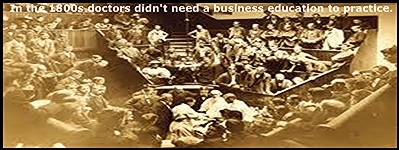
"In the early 1800s medical students who
watched surgery being done on the center
podium must have thought about what the
future had in store for them, a time when they
had no textbooks, learned by hands on patients,
unsterile in all cases, and had the remarkable
courage to do what they had to do to
save a least some lives."
Articles©2013-2022/CGG INVESTMENTS LLC. All rights reserved. #123, 3-16-22
