

"Being willfully blind to reality is like walking around in the bone-yard
of unresourceful thinking and being blinded by groupthink, which
continues to pull physicians into bondage almost too easily, like the
rooster who thinks the sun comes up because he crowed."
The agony and frustration you feel about the situation you find yourself in today financially certainly is not what you intended at the start of your private medical practice. Then you ask yourself, how could all this happen to me? You are likely a very smart, conscientious, and knowledgeable physician, but it still happened almost unnoticed.
It might be just the right time to take a diligent look at what factors have actually led to where you are now. Sure, you may be satisfied living a "lower-middle-class existence," but does your family agree? If they don't, maybe they just reluctantly go along with circumstances that control their lives and learn to live with them.
In order to get a clear grasp about what you’ve accomplished compared to what you could have accomplished in your medical career may ripple your pond. Before we get into the reasons, the blame, the should-have-done, and the things you missed along the way, I’d like to tell you a story that my brother told me.
It paints a real Harvard-business-class picture about business. You are in a business, right? You are working ON a business or IN a business, depending on whether you are an employee or not…concept strange to you?
Within any larger business, especially in an industry like manufacturing, one may find a man named Sam. Sam has been working on the manufacturer’s assembly line for 18 years, doing an exemplary job, works a full shift conscientiously, and is happy and satisfied with his job.
One day the manager pulls Sam out of the line and makes him a supervisor because he understands the job well and knows what each worker should be doing, when he discovers a worker in his crew that is not performing well enough. So, instead of chewing him out, Sam takes over the worker’s job and shows him exactly what he should be doing.
By all standards appropriate to the job, Sam failed at being a supervisor.
On the other hand the manager decides to give the supervisory job to the another employee that is lazy, spends lots of time around the water cooler, always distracted by talking with those
around him.
He is adept at talking about most subjects and really enjoys the interaction with others at work. This guy seems like the worst choice for the supervisor job but excels at his new supervisor job.
The difference here between the two individuals is the mindset of the persons involved. Sam had spent many years in his job on the line. Sam has spent years developing a mindset of doing that job well, better than anyone else could do it. His whole life focus was there and he was happy in the job. Exactly like many physicians do today.
When he was moved to a higher position as supervisor, he failed because he could not overcome his mindset. The mindset that no one could do the job as well as he did it for years…so he could never tolerate anyone on the job that didn’t meet his quality of work.
His deep interest and passion were focused entirely on the line job that he did so well. As a supervisor, he couldn’t change that feeling.
The lazy guy was able to interact well with others because his mindset was on good communications and interactions with other employees. He didn’t need to know what each worker in the crew needed to do, which left him the means to easily deal with any employee on the line openly and not have to do his job for him.
It’s a requirement for being a good supervisor, which Sam was not able to adjust to.
The same concept applies to physicians in private medical practice. Physicians who have spent their younger years thinking about becoming a physician and feeling the need to be healing patient’s diseases and treating trauma. Once they recognize in college that the premed curriculum is something that fits their passion and when they can get into medical school, their mindset is strengthened even more.
In medical school essentially everything they hear, do, and see is focused on becoming a physician and practicing medicine as an expert. The mindset is brought into bondage with that one single focus. So like Sam in the story above, doctors develop a rigid mindset that is laser-focused on practicing medicine and nothing else.
They achieve what, for them, is perceived to be a very high quality of life. Their mind silently covers up the opposing thoughts.
Medical doctors are much more interested in a medical career than most people are interested in their work. The strength of that mindset incites a complete disregard for the business of medical practice. Of course, there are some other factors that seed and feed this process.
Consequences that often result from a disregard for learning medical practice business management, is that physicians…
1. In our present professional world physicians predictably will not be able to earn enough income to maintain a medical practice or meet their family’s financial obligations. Lack of a sound knowledge of medical practice business management is at fault.
This should send a loud message to large numbers of physicians, but fails to do so. As fee restrictions and other mandates increase, lack of successful medical practice business judgments escalates the financial problems for the medical practice business management. The proof is documented by the huge numbers of physicians who have sold their practices to hospitals, quit medicine, or changed professions. Physician attrition is multiplied.
The majority of physicians in private medical practice have no idea about the increasing numbers of physicians quitting medical practice in our nation annually--no records of that, or surveys about that issue are kept, or if they are, it is not published for obvious reasons. You may become aware about that by a significant percentage increase of foreign doctors practicing, or by the fact that American males no longer are applying to medical schools. There must be a reason for that.
2. The present generation of newer physicians have no problem with these seemingly ordinary things because they truly have no expectations for their careers. So about 50% of them grab a 9
to 5 job employed in government controlled medical facilities, work part time, find employment tolerable, and are quite happy taking home an income of $150,000 to $300,000a year.
The astounding decrease of accountability, responsibility, dedication, passion, and obligations among the younger doctors has divided the medical profession--similar to the divisions in our social order and population sectors. Older doctors are wondering why these young docs think this way? The spin-off from this has created a legion of physicians now labeled as"healthcare providers", accepting that they are equal in status to mid-level medical providers, at least in the
public perception.
3. Older physicians are stuck in the financial quicksand not knowing that all of these money problems would have been quickly recognized and resolved if they had had a formal
business education.
As it stands, physicians in private practice today don’t know how to resolve their financial difficulties. They are left feeling hopeless in the quagmire of increasing government restrictions and are being forced into the employee world which has even more restrictions. Freedom to practice medicine as you choose is being chipped away daily.
4. Physicians that have some remaining intellect and experience will recognize they have a way out of this financial-business straightjacket.
Most physicians, unfortunately, believe that the answer of last resort is to leave medical practice temporarily, without an income, to get an MBA degree. What they haven’t been told is that an MBA is essentially useless to physicians, because the business education is too general to be of much usable value to physicians.
Having to pay $40,000 a year to a practice business consultant to run their medical practice business is unaffordable. Facing retirement is the lake of fire for physicians who are suffering from professional poverty… thus they inevitably continue to practice medicine forever. Having no significant retirement plan funded above the $1.5 million recommended by financial experts today is a sad result for spending 30 to 40 plus years in clinical medical practice.
What you can do for yourself today to ease the medical practice financial pain?
Any physician that chooses to continue to maintain their private practice and who also has the desire to learn how to survive financially can easily do so by reading my articles and information on my medical website and reading the specific books on business and marketing that I recommend in my book--- THE WOUNDED PHYSICIAN PROJECT.
The knowledge you need is easy to learn and remember. But it requires some extra work and time…maybe one hour/day at home with your feet up on the coffee table sipping coffee.
You do not need an MBA… got it?
Whose fault is it that you might have to cut your medical career short?
It has to be somebody’s fault… right? It doesn’t happen out of the blue or as the result of demonic possession, although some may think that. There are two clearly identifiable contributors to the consequences resulting from the deficiency of business education.
1. Medical school academics
2. Physicians themselves
The medical school education hierarchy is so busy over-teaching medical students about medical knowledge that they rarely will find a use for later and that can’t find time in that curriculum to sneak in business education at the same time. Truthfully, it’s worse than that.
Medical schools outright refuse to have anything to do with providing a business education for all medical students. For a century, they have for some reason disregarded the other half of medical practice…the business of medical practice.
Maybe they are just dumb because none of them have ever had a business education themselves and so are unable to mentally enter into the reality of business knowledge, strategies,
and benefits.
Could it also be a bit of executive arrogance? Even a fool can come to the realization that running a business profitably requires a sound knowledge of business.
So sending a physician out into the world to start a medical practice business (a requirement for private practice) and medical practice business management with absolutely no business knowledge, equates to predictable failure, first financially, then medical practice
disintegration follows.
Now think about this…if the medical school education scholars are smart enough to recognize they are intentionally causing the financial demise of hundreds, maybe thousands of medical practices over the last 7 decades, wouldn’t you believe that they would do something about that? Shall we talk about their professional education integrity here?
Oh yes, I have one other critical issue that needs exposure. Ask any new physician coming out of medical school if anyone at any time over the four years there ever mentioned the need for business education. I ask that all the time and I have never had one doctor say that they had been told about the necessity of having a medical practice business education.
The second issue that seems to be contributing to the demise of the private practice of medicine is what physicians do and think about obtaining a business education once they begin to see their income decreasing to a dangerous level. At that time it’s often too late to reverse the
financial situation.
Just the fact that no one took the time in medical school to point out the tremendous effect that medical practice business education has on private medical practice management and medical careers, is no excuse for their own disregard for providing or offering a business education.
Are medical students and young doctors totally blind to the fact that medical practice is a real live functioning business-part of private practice? How could any doctor not notice that?
Rarely does one find a physician that takes the time to get a business education. Usually, it happens before they decide on a career in medicine. Doctors don’t get MBAs because most can’t afford it. Most simply don’t feel any obligation to learn business principles.
My take on this is that physicians are resistant to business learning because they have never been told it’s important and necessary. They haven’t been indoctrinated along the way about the great advantages of having a business mind.
If they are not taught that, they will never focus on it, or develop a mindset in favor of a
business education.
Key point: The mindset with a single focus on medical care
and being a physician is so powerful that the idea
of business knowledge is crowded out of importance
and attention… an unpardonable enigma.
The mindset for medical practice exists with no competition from a focus on business. Clearly, one can also develop a strong mindset for business as well. Why doesn’t that happen?
Business knowledge runs in parallel attention to medical knowledge, once it’s created. Unless students on their path to medical school are mentally prepared for and understand the reasoning behind a business education being necessary for reaching their optimal income and professional skills as a physician, they will reject any effort to teach them about business principles.
Every physician, if asked, would likely agree that a business education would help them, even if they know nothing about business to begin with. There are businesses everywhere as far as the eye can see that survive only by applying business principles to their business. It certainly can’t hurt a medical practice or the physician running it.
Along with such a belief, there should be a degree of responsibility and obligation somewhere in their minds to obtain a business education. There is, however, a certain level of education needed about business benefits before physicians will ever accept that a business education is important to them and their career.
When you think about it, it’s incredible that a person can go through high school, college, and medical school and not understand that the source of all money comes from a business of one type or another. Further, they are not able to make the realistic connection between private medical practice and the medical practice business management that makes it profitable.
The economic parameters of successful medical practice businesses are no longer the same as they were a hundred years ago, because change continues to happen as human society advances.
Understanding business and behavior patterns exposes the truth
The marketing and business guru, Dan S. Kennedy, teaches, extreme success with any business and the extreme financial rewards from that business is the product of extreme interest in it. Even to the exclusion of interest in many other things. That extreme interest can be organic or deliberately developed, but it’s required.
The lesson is quite clear to most business millionaires that created their own fortunes. They come to recognize that protecting and growing wealth requires an extreme interest in money, in wealth,
and investing.
The implication is that physicians can and should do the same if they intend to have a suitable and enjoyable lifestyle while they practice medicine and in retirement. You need a complete change in mindset about profits, income, money, and finances. Such a mindset does not detract from the practice of medicine.
A few months ago I was contacted by a physician in Louisiana. He had read a couple of my business and marketing articles on my website and was eager to get my opinion about retirement from practice a few years away.
I like to “Google” the names of potential clients to get background info on them before I talk to them. There were over 20 pages of Google filled with references to his name.
Our conversation was interesting, to say the least. He is a self-made multimillionaire physician OBG with three half-million-dollar cars in his long garage, about 50 yards from his helicopter. The town in Louisiana that he settled in to practice OBG was small and grew up around him.
When I asked him what his income secret was, he said that from the start he thought of medical practice only as a business and over the years maintained it like a business. His practice was huge, to say the least, had a nurse practitioner or two and was solo in his private practice. He never once admitted that he had any business education at all.
The second physician that contacted me also was a self-made millionaire that practiced neurosurgery in Texas near Midland. He belonged to a loose group of about five neurosurgeons locally. This medical doctor had recently become interested in marketing his private practice and had already gone to business conferences.
His call group agreed that he should become the marketer for the group once he convinced them of his old age passion to do that. The call to me was to get my opinion about how fast he could gain expertise in business at his age (I guessed about 70).
The rest of the group had no interest in business or marketing knowledge. I offered him some advice, gave him some education ideas and it launched him into the marketing world of
medical practice.
I haven’t heard from either of them for a few years but I feel that they will contact me later on.
Peddlers of the “escape or balance” beliefs along with the “wealth is evil” crowd desperately need to make you feel bad about yourself for focusing on practice income and doing everything to
raise it higher.
You know...the ones who are very quick to throw the criticism at you for making good money, and say “So you went into medical practice just to make money?” Such a provocative means of intimidation reflects their own lack of business know-how.
They desperately need you to be ashamed of yourself, so they can take money from you somehow. Robert Ringer writes books about this attitude. And don’t try to sell me on the idea that people mired in moderation and striving for balanced lives are any happier or have better relationships and home lives or health than those obsessed by an extreme interest in being wealthy.
Facts don’t substantiate that.
The number one cause of divorce, for example, is by a large margin, financial stress. The top causes of clinical depression are…disinterest in life, lack of accomplishment, and sense of inadequacy whether objectively warranted or not.
When we suppress or seek escape from that natural imperative, all kinds of greater evils than “imbalanced” keen interest, step into the vacuum. For example, alcohol and drug abuse
fill the gap.
The substitution of entertainment for productive accomplishment is moving right along at fever pitch. Our culture is turning into pasture animals, needing to be fed, housed, and watered
by others.
It brings to mind what will happen to the younger generation of physicians who abide by the short hours, pensions held by employers, that don’t care much about salary levels, no passion for hard work, and desire more time off for life’s pleasantries.
Physicians are happier practicing medicine than they ever are retiring. Physicians who earn a lot more money using business principles are a lot happier than doctors who don’t know about business and have an income that barely keeps them in practice.
Medical practice provides the gratification, feedback, and accomplishments that enable satisfaction with their careers. But when the income drops and they have no way to compensate for it, life and careers are miserable. That’s exactly what we see across the profession today.
----Professional Probe----
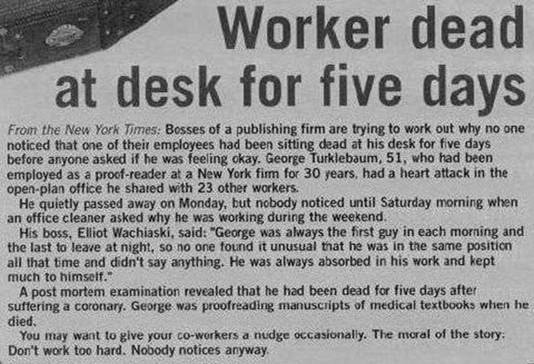
"Can this story be the result of a
department full of employees who
all had extremely focused mindsets?"
"Some things in this 'world exist or happen and yet are
hard to believe. One of those mysterious events
was reported in the newspaper."
"It's almost a unanimous belief among physicians that business
knowledge neither magnifies the income and success of
physicians in private medical practice nor is important
enough to their ultimate income and satisfaction
to be worthy of any legitimate concern."
"Might this newspaper clip resemble physicians who work in their
medical practice business daily and see no business existing.
And, even worse, ignore the "business" element
of medical practice entirely throughout their careers?"
Articles © 2013-2022/CGG INVESTMENTS LLC. All rights reserved. #66, 3-16-22
