

"Your frustration is easily recognized by your patients
and creates doubt and mistrust in their eyes because it
reveals not only problems you don't seem to be handling
well but also your lack of confidence in resolving the
issue. And if what they notice and think is correct,
then how will you handle their medical problems--
in their minds?"
You have about 9 seconds to let your patient (new or old patient) know that you are interested, authentic and important to trust. In the 1950’s the attention span was 20 minutes and now is scaled at 9 seconds. The speed of healthcare today for all the various reasons you understand, has evolved into a revolution in the way medicine is practiced today.
The onslaught of being forced to repetitively keep adapting to the constantly changing patient and professional environments is overwhelming for any practicing physician. Now you have to cram all you have been taught to do into a time frame that any conscientious physician finds inadequate, let alone terribly frustrating, to maintain your quality of your healthcare services.
However, there are a few methods available to enable you to comply with the constricted time demands of medicine practice business today which will help eradicate a good deal of
your frustration.
The only physicians who honestly understand the extent of the before and after transition of medical care over the last 50 years are in their 60’s, 70’s or older. Newer generations of physicians don’t have a clue about what the old timer’s challenges have been during those years in practice. Their old challenges were different, but today they are new and even more intolerable--like a patient who is demanding you prescribe a certain medication for them.
As a consequence of the persistent and increasing challenges, older physicians would rather quit medical practice management than continue in a profession handicapped by regulation, intrusions, and restrictions.
You may already know that physicians are leaving medicine in droves at least 20 years before they actually intended to stop practicing because of burnout. Consequently, the shortage of physicians today has become a serious problem that the medical educational system fails to resolve.
Medical school scholars and leadership have no clue, (or they know, and purposely avoid, the necessity of the one change/addition to the curriculum--business education) as to how incredibly important they are to the survival of private medical practice.
These are the medical scholars that authorize medical school curriculums...
The leadership and creation of medical school curriculums is a major function of the AMERICAN ASSOCIATION OF AMERICAN MEDICAL COLLEGES.
Their mission is to...
SUPPORT POLICY RESEARCH IN MEDICAL EDUCATION AND SERVES THE ACADEMIC MEDICINE COMMUNITY TO IMPROVE THE HEALTH OF PEOPLE EVERYWHERE. THIS ORGANIZATION'S MOST INNOCENT AND YET PROVACATIVE PURPOSE IS TO MANAGE OR CREATE CURRICULUM CHANGE IN US MEDICAL SCHOOLS IN OVER 174 OF ACCREDITED MEDICAL SCHOOLS, among others.
So I have to ask, "If their purpose is to improve the health of people at least in the United States, why haven't they recognized the one single primary cause that is responsible for increasing physician attrition, disintegration of private medical practice, a tsunami of private practice physicians who have been losing their medical practices for financial reasons, persistent reduction of American male applications to medical schools, the inability of large numbers of physicians that can't make enough income to send their children to college or fund their own retirement programs, and today are being forced out of private medical practice by government fee restrictions and increasing mandates regarding medical practice---the lack of a formal business education.
Physicians are tired of the struggle and the disappointments they have endured. Who can blame physicians for dropping out? Understandably, most physicians have compensated for the series of "forced changes" by relying on increased patient rapport and harder work. But those efforts no longer save their practices because 98% of physicians who manage their own private medical practice businesses don't have the recommended and necessary business tools to use that are mandatory for survival as a real business entity, let alone a persistent successful future.
This effort to try to keep their medical patients loyal to them as best they can, eventually stopped working. Physicians have found no alternatives for handling the process of doing more in a shorter time productively, profitably, or persistently. The good news is there's a way to
do that today.
The new “fascination” approach resolves most of that dilemma...
Your medical practice failure in this case example is one of finding reasonable and profitable alternatives. “I give up,” is the one most physicians have found to be the most beneficial. Quitting practice is quick, bloody, and desperate, but does not offer satisfaction either.

There’s a new and efficient alternative available today that works in any business and has come to the forefront in the past few years. It’s a way to change your medical practice business based around who you are. It’s how your patients see you, not about cost and profits in your practice. Clearly, it’s a fishbowl effect for you.
Patients today are attracted to you because you are fascinating in one way or another. Your skills, talents, and medical knowledge take on a secondary role in the eyes of your patients. You win by becoming fascinating, or in some way becoming celebritized. The Hollywood culture has invaded the healthcare industry and our medical culture.
Today you should be thinking about marketing yourself rather than the fact that you can surgically remove a gallbladder in 30 minutes. Social importance has camouflaged all the talents and skills
you may have.
Patients' perceptions of your value to them evolve from what they see you do, how you act around them, and how you treat then. Patients don't ever see or learn how fantastic a surgeon you may be, even though you pride yourself in the quality of your surgical expertise and unique
medical knowledge.
What patients see are the results of what you do for them that increases the quality of their lives. Think about it. A good example is the “celebrity effect” on people. Fascination with celebrities has become an overwhelming influence on our thinking from presidential campaigns to medication advertisements in the media.
How many times each day do you come into contact with marketing efforts focused on what a celebrity believes, says, or does? Recently, Dr. Fauci, public health administration, shows you
how to do that.
Celebrities are fascinating to a majority of people and patients. Using celebrities and their fascination, works wonders for attracting customers, clients or patients. It doesn’t mean you have to sing, dance, and play the guitar.
When a physician or any professional elevates themself to a position of recognition and prominence, (celebrity status) your patients interpret your prestige as going the extra mile for your patients. It reflects that you care (a social element thrust into the patient’s
decision-making perception).
Being known in your community by all the events you support, charity work, support of sport teams, leadership positions, and media coverage is someone your patients admire and want to be around.
Like it or not, your being seen in lots of places outside your medical practice, positions you in a celebrity status. Patients want to be around such people.
It’s not what you do, but who you are and how you perform in a natural way. You can fake it, but patients see through that façade in a second. When you pretend you are something you aren’t, you hate what you do and what you get.
Most medical practicing physicians today seem to ignore doing the things that build their reputation and expertise. That's not good enough. It has to be intentional and deliberate.
You can be fascinating by what you have on your business cards, office stationary and on the walls of your office.
Every time I accompanied my wife to see her orthopedic surgeon, I stopped a few minutes along the hall to check on the newest plaques, recognition awards, certificates of thanks, and photos of the organizations like the little league team he supports.
What’s fascinating to me is how this busy physician can have the time to be involved in all these outside events, especially when I never could. Yeah--you know they are trimming something. The solution to that is joining a group practice.
Wouldn’t every patient feel reassured of your authenticity and trust by seeing all those recognition awards? You can bet on that. This social push amps up all parts of your medical practice business. You are also in a position to choose the patients you want from the many that arrive at your office.
Do you have all your accolades easily visible on your office walls and in your patient’s view?
These are a few things you can do to build your medical practice business...
1. Every time you make a public presentation, give a talk or lecture, someone
in that audience will become your patient or at least refer another patient to you.
2. Every time you appear at a charity event and support that event, you
will attract another patient.
3. Every time you volunteer to teach a class at our local community college,
you will get another new patient.
4. Every time you volunteer for a local community project you will find a
new patient at your door.
5. Every time you support a political candidate giving a campaign talk,
you will eventually attract another patient.
Every person loves to connect with those having similar interests, no matter what they are.
Your patients are not shopping today for your expertise, but for who you really are and how you treat your patients. The profound expansion of social networks online is a reflection of how important it is to everyone in today’s world. Almost every successful business today is active within these social networks business wise.
Being in contact with a bunch of real people any time of the day or night is somehow fascinating to everyone. We are born with that sense of attraction to each other.
You would be wise to build your medical practice business around who you are, not what you do.
Where did all this fascination system come from?
The one person who researched, developed and teaches businesses about this means of maintaining and growing their business among the Fortune 500 companies today is a very passionate and intelligent lady named Sally Hogshead.
She has spent many years perfecting her system to the point that anyone can use it reliably and repeatedly forever. She teaches it and promotes it worldwide. The value of her system has proven to be highly successful in the profitability of businesses.
Medical doctors often relate their medical practice to the universal commoditization of medical practice in the USA with over a million doctors all doing the same thing, practicing medicine. More precisely, you need to move to who you are in the profession which makes you different from all the others.
You start by asking yourself two important questions. ..
- How do my patients see me? Have you ever asked them?
- What do I see about them and their “behavior type.” (called "archtype"...explained later)
We all give off silent message signals 24/7. The trouble is that we have no idea what signals we give off to others, nor how they are interpreted by other people. Some are the words we use and the intonation of those words. Some come from the questions we ask, and even how we ask them. We give off body and emotional signals continuously, whether asleep or not.
Signals we project are unconscious and involve all the senses.
If we understood what signals we are giving off to patients, we would be able to improve our communications with patients in more advantageous ways.
If we could understand the signals that our patients give off, then we could improve our perception of what they really want much faster. Being more sophisticated like this in what you do around your patients is far superior to what most doctors do today.
The whole concept of signals we give off is well researched and proven to not only be factual but also quite important to all communication among people.
The question is how do we find out what signals we give off to our patients without even recognizing it’s happening. That’s what this new approach to our patients exposes and how to use those factors to become better doctors. In turn, you attract new patients you likely would never have recruited.
How does this fascination system work?
Sally Hogshead has created a question answer test with the assistance of other experts that defines the seven critical fascination triggers which are specific to each persons
life and personality.
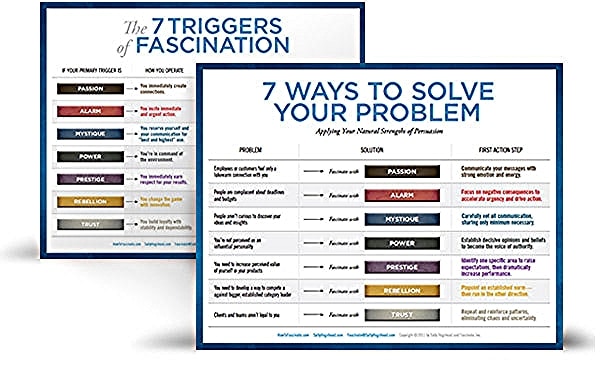

You may respond to one or several of these triggers (which the test questions expose) based on
the many aspects of your personality and belief systems. When the test points out what your dominant triggers are, there’s a predictability to how you will respond to and handle your patients.
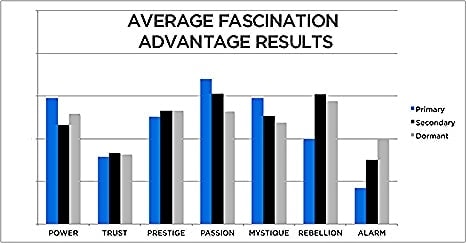
All are useful triggers and no one fails the test. However, there is much more to the process than triggers. Triggers are controllable and predictable.
Table 1. Chart For Determining a Person's Archetype
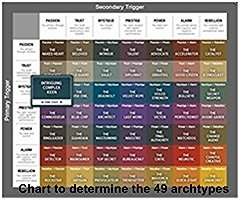
All graphs and charts are downloadable from sallyhogshead.com are free.
Next, your dominant trigger points allow you to be classified in one of 49 archetypes. This is a system that is able to measure the signals you send out to others. By cross-referencing your specific triggers with the chart of the archetypes, your archetype appears.
You are focusing on your own core values and not on external forces. It’s a psychological platform and you can easily learn how to leverage it. Your archetype tells you how you respond to your trigger points. Patient's archetypes are recognizable and directs how you approach them.
This system is used frequently by other professionals for their own business reasons.
For example, copywriters send the test to their clients, place them in their archetype category and then are able to do a much more satisfactory job of doing copywriting that is more pleasing to their client. Knowing the trigger points of a client enables the copywriter to use the words, flow, context and intent that matches the client’s primary dominant triggers.
Copywriters are paid a LOT of money for what they do. If your kids are constantly at their computer, you might push them to a career in copywriting. It's in great demand and the pay is better than most businesses.
Implementing such a system into your medical office is not difficult to do. Every new patient you add to your medical practice business is given a form to fill out which includes contact information, prior medical history, and etc. The survey or test form for this system can be completed by your patients at the same time and coded to their medical record.
The advantage you have doing this provides a much clearer understanding of the behavioral patterns of each patient archetype and the best means of interacting with them. Your office personnel will have the same advantage.
The results of the process allows you to get to the patient's problems much faster, treat them with less resistance, and create a quicker rapport with your patients at the same time. The advantages include more than you might think.
By improving your patient communication in a fast moving medical world, you will...
- Create better patient loyalty and trust
- Be able to provide medical services much more satisfactory to
your patients
- Patients will send you more referral patients (free marketing)
- Be one of the rare physicians who provides healthcare far superior
to others and in a more efficient and rapid manner
- Recognize your patient’s medical issues specifically and provide
treatment most likely to be agreed to by that patient
- In the long run, become a much more competent doctor and
receive many more patient referrals from other doctors
- Reduce the risk of medical malpractice actions against you
Therefore, when you know the triggers your patients have, or recognize the signals they are sending out to you, you are able to get to their medical problems and treatment faster, see more patients than usual and fascinate them over and over with your clear understanding of them.
Learning your individual strengths and using them in presenting yourself to your patients (marketing yourself) is powerful and productive in medical practice. The unconscious signals your send to your patients, once you know what messages you wish to send to your patients, can be consciously controlled.
Do you usually always seem to be in a hurry in the exam or consult room? Do you take a few seconds to greet your patient or even begin with a handshake?
Are you quick to respond to your patient’s phone calls for help? You know what aggravates or pleases you when you visit your doctor, so start there with your efforts to send the right silent messages to your patients. Do it even if you only have the average “8 minute office visits” where other doctors could care less.
Comments...
This approach to your patients provides you an alternative means of reducing your frustrations with medical practice—instead of quitting. Your own subtle and silent signals being sent to your patients may be killing your medical practice business without you ever recognizing it. It’s an infection that most employed physicians eventually seem to get.
Whether you believe this is worth the effort to implement or you feel that you don’t have enough time to make it work for you with your patients, the exact same wrong signals you are sending to your peers, friends, and those you meet may also be having a significant negative impact in your social life as well.
The tragedy is that great numbers of professionals go through their whole careers wondering why they have trouble with retaining patients, friends and respect from their peers.
You may be a physician who is well aware of this phenomenon. Understanding your archetype and personal triggers, regardless of the value it has with treating your patients, is something that should not be shrugged off. It truly affects every aspect of your life in one way or another. It’s a fact that can’t be denied.
On the other hand, you may still be in the arrogance phase of medical practice. You know…the time when you believe you have all the tools you need to reach the top and stay there. Then, what do you have planned for yourself when you lose your self-importance and need to rely on some other virtue, trait or characteristic to hide your insecurity?
A critical aspect of a successful medical practice business is to know who your patients are, what they are thinking and what they want.
A foundational function of medical practice marketing for your medical practice today is to follow the society trends in order to meet patient’s demands. When you’re aware of what’s influencing your patient’s so strongly, you can relate to them on a mind-melting level platform (you are connected instantly).
References:
- SallyHogshead.com (Hog Blog)
- Howtofascinate.com
- Fascinate, book by Sally Hogshead
----Professional Probe----

"Traveling Physicians in the early 1900s"
"Town calls, not house calls"
This 1920's advertisement is a clear example of how much a physician's image has changed over the last century. It was a time when it was a privilege to be seen by your doctor regardless of his personality, habits, or beliefs.
Today, our profession is a commodity promoted by big government to serve the healthcare of the masses regardless of personal medical career goals. The competition for survival in private practice now is relegated to the complete opposite of the 1920's.
In essence, physicians must become much better salesman by promoting themselves instead of their products or services. Survival today in medical practice has become a medical service dominated by the social dynamics of a society that expects physicians to bow to the religion of celebrity to survive in private medical practice.
Articles © 2013-2022/CGG INVESTMENTS LLC. All rights reserved. #48, 3-16-22
