

"The essence of establishing patient relationships...
something we older physicians used to call,
'rapport'... is far more important than your
medical knowledge for retaining loyal patients."
One of the least discussed medical practice marketing strategies continues to be one of the most important--that of retaining loyal medical practice patients. The cost of retaining a medical patient is known to be several thousand dollars less that the cost of obtaining a new patient.
By far most patients leave a medical practice because they don't like the way they are treated by the office staff or by the physician. Follow-up on the medical patients who leave your medical practice is important because it would be an indication of something wrong with the medical practice management that needs changed. It could be the result of one person on the office staff who is treating patients rudely or could be how the physician may be too gruff or not interested in the patient's medical problem.
Whatever it is that makes a patient aggravated so severely that they leave the medical practice makes it very necessary to find out what it is. That problem usually turns out to be a recurrent problem or a persistent problem that often becomes known to the medical community soon after.
Some patients just put up with the problem and keep quiet about it because they don't want to create a problem in the medical practice business and become known as a trouble maker. In the worst cases, the patient goes directly to the physician for resolution, but most won't. They will just go to another physician and you never find out about the problems.
Someone from the office should call every patient who leaves permanently to see if there is a complaint or not. The problem is that most patients who leave because of an office problem won't answer the phone or discuss the issue. If they do talk about it, it's only because the office staff caller is exceedingly nice and respectful, especially if the purpose is to improve the treatment of patients.
Sometimes patient expectations for their medical care are way too high...
Ever wonder why your patients chose you for their health and medical care rather than another physician? Have you ever asked them? It might be a very smart idea to do it.
Some physicians exploit their surgical prowess to draw in patients. Others attract patients who need their doctor to dictate to them in a strong fashion what they need to do. Well, those approaches work well for some physicians to recruit patients, but patients do not stay long in those practices.
Most physicians prefer to have their patients remain in their practices for long periods of time where good rapport is developed and consistently results in more efficient and better medical care. You already know that--but, is that really why your patients keep coming back to you?
Surgical specialty physicians operate on a patient, insure they heal normally, and further services aren't usually needed... they're cured. But, how the patient is treated during that experience will determine whether they return to that doctor for the next operation they need... similarly, they continue with your care because of how they're treated.
One fact is clear. You'll lose patients right and left if your personality leaves a lot to be desired. Marketers know that most purchases are based on emotion, and later rationalized by the left brain. The key here is how you respond to your patients in an emotionally positive way. People buy the new car often because they really like the salesman, what he says, and how he says it.
Consider then some of the emotional factors in relating to patients that make or break your rapport. Let's call it your "patient" personality...
- Greeting your patients
- Discussing medical treatment
- Respecting a patient's choice
- Offering options to their care
- Being willing to adapt to their whims within limits.
A. Greeting
We're taught in medical school it's important to avoid a bad attitude when treating or consulting with a patient, no matter what is going on in your thoughts or your environment. Even if the patient you are seeing belongs to one of your associates. Makes sense, doesn't it?
First impressions are immediate in a patient's mind. The second you walk into the exam room the first time the patient senses your body language, mental preoccupation, and voice tone characteristics, all of which tells them what you may not want them to recognize. So, what's your tactic for disemboweling yourself of that invisible cloud you are carrying around with you?
My suggestion is first... make it a habit pattern of making eye to eye contact
with the patient immediately and maintain that until you have finished your
verbal greeting.
- Not making eye to eye contact, immediately indicates to the patient you are too busy to take much time with them--your mind is somewhere else--you don't want the patient to present you with 10 medical questions, thus isolating yourself from the patient in that manner, you lose trust, respect, and professionalism.
- I have a VA doctor of middle East origin, whom I see on occasion who walks into the exam room head and eyes fixed to the far wall, no greeting at all, spends 6 or 8 silent minutes on the computer reading my medical information, then speaks his first words to me without even looking at me. I have the urge to punch him every time. At least I should have the professional arrogance to tell him what I don't like about him.
- Second... the verbalized words should be pleasant, oriented to the patient not about yourself, and content should be different, yet interesting. Something like, "Good morning Mrs. Nelson, I trust you are enjoying the sunshine today--and even do a little shopping after your visit here."
- Recognition is a communication everyone is looking for. By far, the best way to do that is by saying a patient's name. It opens up your respect for them and allows for much better history taking. Adding some humor is often a good thing. The reference to a positive aspect of our environment (sunshine) gives the patient a few seconds to enjoy the moment, reduce the "white-coat" stress, and create a positive mental image about the visit.
If in the greeting, you mention something that the patient can respond to with a "yes" response, it sets the positive direction to what follows. - Third... make a real effort to make a physical contact with the patient, usually in the form of a handshake, a light touch on the shoulder, or a gentle grasp on the forearm. It works wonders.
- People understand the value of human touch, whether it's a handshake or pat on the back. Touch sends an unconscious message to the patient that you have concern for his or her welfare, and want to know more.
B. Medical treatment discussion
Your ability to focus your attention on the exact information the patient wants to know and understand is critical. I'm sure every doctor has heard a patient state that they went to a doctor who never explained anything... just handed them a prescription and walked out of the room.
Nothing is more appreciated by a patient than a doctor who explains what he advises, pro and con, and why it's important. And you can believe that same patient tells 10 of her friends how thorough you are. Even recommends you to their friends. That's free marketing going on for your benefit if I ever saw it.
That extra two minutes of attention to such things performs miracles.
C. Respect Patient's Choice
You don't have to agree with it, but you have to respect the right of a patient to refuse treatment, or modify your advice to fit their wishes. In our community, it was rare to find a physician who would accept a Jehovah Witness patient as a surgical patient. I did, and never regretted that decision ever. This religious belief of no blood transfusions can be a hurdle for physicians who
are risk sensitive.
Being clever enough to persuade a patient to do as you advise by using certain tactics that accomplish the same thing and yet the patient agrees with, is an outstanding boost to your self-esteem. Sometimes it takes a bit of humor to accomplish that.
I remember a patient who commonly told me she never bothered to take all the medication as prescribed by any doctor. I told her I'd see her again in a week to see how much the
problem had increased.
Often, that brought a chuckle from the patient and a non-verbal compliance from the patient. It doesn't always work but you can figure out angles and comments that patients will go for.
D. Offer Options
Every patient enjoys choices of treatment. It's a courtesy to present options of therapy while being careful to look for how the patient responds to each--especially when you explain the pro and cons of each method of treatment. Most will agree to the one you think is best.
What does a physician do when the patient flat refuses the suggested treatment? First, it usually becomes a verbal wrestling match. If you find the patient sitting on top of you later, it's time to exit the ring, or begin your "sweet talk" and stories. Paint a picture to the patient of what happens to many patients who refuse treatment or the medication.
***This lady patient was a nurse who had been office manager for a "naturalist" doctor who treated with various plants and the like. She was about 38 years old, intelligent, married, and was having mild vaginal bleeding that was persisting. Pelvic exam revealed a raw looking cervix so I did a punch biopsy which was positive for Stage I cervical cancer.
I called her the results as she requested and we had a sit-down discussion about options for treatment. Stage I cancer of the cervix has a 99+% for cure at that stage of involving only the cervix itself with a vaginal hysterectomy.
She instantly told me that she would not have surgery in spite of the excellent cure rate because the doctor she worked for could cure her cancer using natural meds. I was astounded at that claim.
Her husband agreed with her decision, but I did suggest to them that a consultation with the University Hospital cancer specialist would be advisable. I assumed my ability to change her mind was poor, but she agreed to finally go to see that physician. I got a call from the cancer physician telling me she never showed up for the appointment.
I never saw her again until two years later in the evening when I received a call from the ER doctor telling me that the patient he was seeing asked to talk to me. When I saw her lying almost moribund on the litter, emaciated, husband beside her,
I knew immediately who I was seeing and what was wrong. She spoke quietly to me, saying that she just wished to say thanks for my talk with her back then. She was admitted and died the next day.
****It was a tearful meeting that I will never forget in my lifetime.
When only one option for treatment is offered by the physician, and may be the best one in your opinion and experience, the patient tends to believe you aren't keeping up with newer medicine
and treatments. So offer more than one option for treatment.
Being dictatorial towards the 2021 kind of patients is a big mistake. If you treat older geriatric patients, who are used to the old times when patients were uninformed about medical treatments and physicians were trusted to dictate therapy without being questioned, you may get by
with the tactic.
E. Adapt to a patient's whims
It doesn't mean you let the patient have full control of their care or tell you how they insist on being treated medically. The patient may have something going on behind the curtains you don't know about. Responding to the patient in a suggestive manner so as not to corner them, will permit you leeway in their treatment and your exam.
You may believe that it's logical and prudent to remove the patient's appendix while you are in the abdomen doing benign surgery on other diseased organ systems. When a patient refuses that procedure, how would you respond?
****Because of my experience at 8 years old with a rupture appendix, rush surgery 20 miles away, in 1945, and kept in the hospital with peritonitis for a week or so, I have always been biased about removing the appendix any chance I had. I hate that little sucker, still do.
I never wanted anyone to go through that problem if I could prevent it. I got permission to do that from my patients, recognizing that the occurrence of appendicitis is about one in 200 patients. Other doctors criticised me as expected.
When I began doing advanced laparoscopic procedures, I continued that. After I had removed a normal looking appendix and path report showed bowel cancer, I felt like it was very worthwhile to have continued doing the procedure. Saving one life by catching it early, saving the patient is a very good feeling. I never charged/billed for that procedure.
****It's the same feeling I got when the mammograms showed no evidence of cancer traits in my patient, the persistent lump I biopsied anyway, showed cancer, and she was cured.
Some patients just want to keep that "wormy little dangler" for some reason or another that one can never understand. The decision to agree to leave it alone, in my opinion leaves a potential risk for patients and has essentially no serious consequences from removal of the appendix.
Another patient issue I had was not with the adult daughter patient, but with her father who forbid her to permit an appendectomy, which I did, after confirming the issue with the patient herself in the preop room and the procedure was on the op-permit.
Summary:
Every single one of these factors generates patients who go about town bragging about you, recommending your practice to everyone they meet, and definitely increases patient flow into your practice, let alone increasing your medical practice income.
This free medical practice marketing strategy is profoundly profitable to you in the long haul. If you already have way too many patients and want less of them, then it's time to start catering to a different group of patients in your practice.
----Professional Probe----
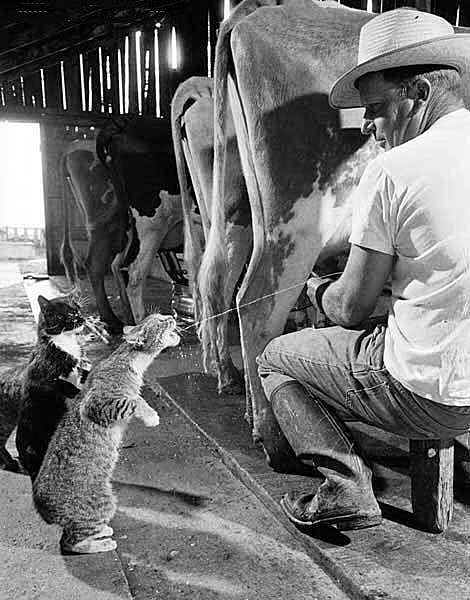
"You don't believe your patients
won't come back for more, when
you continue to resolve their
hunger for good medical care?"
***********

"My grandfather with my kids, my little niece,
Christopher, and Susan."
My grandparents raised me on their 100-acre
farm up through high school and college. This is the
tractor I learned to drive when I was about
12 years old. And yes, I watched my grandfather
while milking the cows often did with the cats
like in the photo above.
Articles © 2013-2022/CGG INVESTMENTS LLC. All rights reserved. #78, 3-16-22
Articles © 2013-2022/CGG INVESTMENTS LLC. All rights reserved. #, 3-16-22
Articles © 2013-2022/CGG INVESTMENTS LLC. All rights reserved. #, 3-16-22
