

"The client or customer is attracted to your subject line or title or opened your letter message... now what do you do to instantaneously make that person read the first paragraph?"
(Part 1 – was about getting their attention first of all)
Every time you write something to any person, organization, company, or medical patient you are in the business of selling whether you believe it or not. You are in the process of directing or persuading the recipient to respond, take action, or listen to your proposition.
You have to convince the recipient that there is a message below that is of great value and benefit to them. At the same time you are intuitively telling them that if they don’t read the message, they will either miss-out on something worthwhile or may lose an opportunity to accomplish something that will make their lives, business, or organization better.
This written message structure is valid for every literary format—email, letter, white paper, resume, business plan, article, advertisement, nonfiction book or novel, report, business letter, treatise, or book chapter that you write.
Many of you younger physicians likely didn’t have writing classes, structuring and diagramming sentences, handwriting, vocabulary tests, or learning the “times tables.” Computers have replaced the need for learning those processes, but are not always available when you need them at the moment. So, now you need to learn how to fill in the blank spaces that you never learned.
Second step in effective copywriting...
Please Note: Next you will be learning how you have always been mentally captured and then influenced in every ad, advertisement, and pages you have read for the last 50 or less years in your life that you either never knew how you were being sucked into an offer, or were rapidly convinced about your need for such a product, more information, or bought into the offer which you later regretted.
Placing the first sentence, first 20 words of so, and the next paragraph in front of the reader’s eyes and make them read them, is the next essential. Your word selection should be laced with thought-provoking and enticing keywords. This line of text is what triggers the desire of the reader to read further into the message. Words need to instantly convince the reader that it is in their interest to continue reading.
Remember, right at that moment of noticing the headline the mind and attention of the
reader is involved in a mental conversation with themselves. Your job is to use words that chisel their mind away from that mental conversation and transform their strict attention to your message. It’s like saying, “Shut up, pay attention!”
The difficult part is to do that in 6 to 10 seconds, the average attention span humans have
in the world today.
An intentional effort must be made to create such an outrageous or profound opening sentence and paragraph. It’s not something you would normally do in everyday verbal conversation. But it is the one thing you have to create that will coax the person on down the page.
The first line of text paints a picture to them that you are showing respect of their valuable time. You are showing them a promise in that line of text that you will provide excellent information on the topic that will benefit them. It also, being direct about your point being made, separates the readers into those who want to know and those who don't.
You recognize their time is valuable so you intend to be direct and wish to save them time. Printed news articles are a good example of how to do that. Your intent is to keep those reading who are interested in knowing what you have to say.
Newspaper articles are almost always telling the who, what, when, where, and how at the beginning of the report or article. They know how to unload a message in the first 10 lines or so to keep the interest of the reader. The rest of the article is just to fill in the less
important information.
Unfortunately, you probably were never taught such important things in high school or communication courses in college. That gap in your education results in compromises to your communication efforts for the rest of your life… unless you do something such as taking time to learn copywriting. You want to bring your communication skills up to par with those whom you need to associate with in your personal and business life.
Linguistic experts pull their hair out (some call it "follicular terrorism") whenever they read most written messages today. You might want to read what Stephen King says “On Writing.” Better yet, get Denny Hatch’s book, “Write Everything Right.” I gained far more grammar, writing, and copywriting education from Denny’s book than any other publication about writing and using the right words. We are constantly being judged by our written communication skills.
Learning all of these many secretive elements about copywriting has far more advantages for you than just learning how to make your writing effective. You will find yourself adapting these "triggers" to your everyday conversations, your public speaking, your approach to altering the behaviour of your kids, and your approach to your peers, who have no idea what copywriting
is all about.
My grandfather taught elementary school for over 22 years and drummed the basics of written language use into his student’s minds so thoroughly that it would have made Strunk and White, “The Elements of Style,” stand up and cheer his passion for teaching the communication of
the written word.
My teen age years were spent living with my grandparents so I had first-hand knowledge and inspiration for that necessity.
Your first 10 words of your message create the passion for the reader to read further.
“Your first 10 words are more important than the next 10,000” –Elmer Wheeler says. Create a
lousy lead sentence and likely the reader will go no further and you will have lost another sale of your thoughts and ideas.
Will Shuck wrote: “I am sick to death of the anecdotal lead, that annoying habit of news writers to start a straightforward story by painting a quaint little picture of everyday life.” –like, “It was a dark and stormy night…”
To make the sentence so loud and fascinating one must include the special words that supply the reader with the elements they are looking for... benefits, needs and desires of your audience.
The choice of the right words, used in the right manner, and surrounded with the conscious and subconscious meanings and implied value draws strong curiosity that the reader is forced to satisfy. Samuel Beckett wrote, “Where now? Who now? When now?” in “The Unnamable.”
Your first sentence has even more importance than simply how it is constructed. Readers remember a sentence that jolts their mind far more than the other 10,000 words below that. The memory of the starting sentence then brings back memory of the other basic points being made
in that copy. The same effect should be used in public speaking and lectures.
The reason is that your senses record all the feed-in when you read it, whether you remember it or not. By remembering the first sentence it triggers the release of other associated memory… the job of the subconscious mind is to do that.You can test yourself on this memory issue.
On any list that you read, studies have demonstrated that people most often remember the first and last items on any list.
The second sentence function...
The work of the second sentence is to grab the effects of the first sentence (unforgettably relevant, useful, truthful, beneficial, tempting, strong identity with) and effortlessly transfer the reader to the third sentence… and so on throughout the treatise. This effect is called “maintaining the flow.”
“You can’t bore people into buying your product;
you can only interest them in buying it.”
---David Ogilvy, master copywriter
A continuous effort to break the visual monotony requires a riveting attention to factors that will kill a reader’s attention. For example, pages jammed full of dense text with no real open space is like a gray cloud covering the page and it’s way too hard to read.
“Neatness rejects involvement”, says Lew Smith. In other words, the way to hold attention is to not be neat, break up the page with such things as varying size of letters, associated messages or information, photos, boxes holding text or images, bold headlines, and magnetic words.
Ways of preventing visual monotony...
1. Sub heads: These are headings that are placed between
the top primary heading or title and the beginning of
the body copy. Some headlines that are too short and are
not enough to interest the reader. Placing a short, less
than 26 words, subtitle below the headline provides the
reader with additional information concerning what the
article is about and increases the reader’s curiosity.
2. First letter of the body copy: by placing a large
initial letter of the first word is known to increase
readership by about 13%. Many make the letter with
a fancy font style. Others italicize the first sentence or
somehow make it stand out.
3. Crossheads: It’s important to add a crosshead down
from the top about 10 lines of text from the top.
Crossheads are essentially a topic title for what lies
below the crosshead (tells what the next segment
is about).
You should have a series of crossheads throughout
the message. There should be about 1 to 3 crossheads
on every page. Each one strategically leads the reader
down the page visually and continues the message
logically to carry the reader through the full
information experience.
Another advantage is if the reader is interrupted
by the phone or ringing of doorbell, they can easily
return to the spot where they left off.
Ways to increase readership and readability when appropriate...
(From Ed Elliot’s work)
1. Best readability is created using white background/paper with black font lettering.
2. Use bulleted or numbered lists rather than crowding the info
into multiple long sentences
3. Use headlines (maximum of 12 words) and subhead lines <26 words
4. Use tables, charts, and graphs
5. Use photos of people in action
6. Use enlarged numbers followed by bolded text
lede to introduce the list elements
7. Table of contents when appropriate
8. Use photography always with a caption below
9. Use an important word or subhead which is larger,
bolder, blacker or has a different
color than other elements on the page
10. Use words of sentences set off at an angle, in a box,
or use different font
12. Use text inside an arrow or ruled box
13. Use quotes
14. Use handwritten notes or doodles to indicate importance
15. Use font size of 10 or 11 points, or 12 for older readers
16. Column width 35 to 55 characters, or line longer than
75 characters (including blank spaces)... 66 is ideal.
(The lines of text on this page average 68 to
70 characters in length... counting spaces.)
17. Better to leave ragged margin on right side of text
18. Avoid light text on dark background
19. Avoid flush margin right or centered paragraphs
20. Avoid tight spacing of text letters
21. A long dash instead of using parenthesis to
separate thoughts in a sentence allows the eye
to jump easily past the gap, but parenthesis
stops the eye from moving across the page
smoothly and implies exclusivity.
22. The soft transition (e.g. Sadness … leads the)
is more emotional and personal.
23. Use “leading” between paragraphs – you lead
the eye easily from the end of one paragraph to
the beginning of the next paragraph. Example of
a short sentence to use at the end of a
paragraph... “There are a few more things you need to
know about.” It increases the readership by 12%.
24. Ideal length of a sentence 17 words (standard).
The increased difficulty of reading begins with
8 words (easiest) up to 29 or more words (very
difficult to read).
25. Best length of any sentence is 9 to 12 words...
29 words long is extremely difficult to read and
interpret the meaning.
26. Best not to create paragraphs that go longer than 5 lines.
27. Block paragraphs are fine for business but indented first line
of paragraphs is much more personal.
These are some of the common and practical writing guidelines to follow that make you look like an experienced copywriter. I hope they can significantly elevate your communication potential, especially when there are times that are critical to your medical career or medical
practice future.
(Part 3, will be about “why Sarah can’t read” and the critical value of applying copywriting to your business, inside and out.)
Yep--another reminder to follow...
Requirements for maximizing your medical practice income...
1. Good knowledge of medical practice management
2. Having the energy for continuous medical practice marketing
3. Medical practice business planning is important.
4. Marketing for physicians and their office staff is a winning set up.
5. Learn what makes a medical practice business successful.
6. Your medical practice business system is essential.
7. Bothe practice marketing and physician marketing is rewarding.
8. Business success is the objective of all physicians in private medical practice.
9. My business website—www.marketingamedicalpractice.com
----Professional Probe----
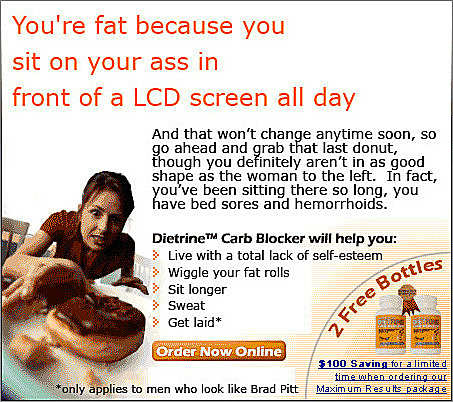
"This ad is terrible because..."
1. No title, that provides a benefit...
2. The "pretend title" is an insult to most people
and should be a subtitle that adds new information...
3. The first paragraph continues the insult so why would
anyone read any further, let alone trust the product.
4. Celebrity use is ineffective because Brad Pitt likely
never used the product, or they would have said it.
5. No information about what ingredient is in the product,
carb blocker is likely "sweet and low" powder.
Articles © 2013-2022/CGG INVESTMENTS LLC. All rights reserved. #60, 3-16-22
